
Current social media trends in 2026: what matters most
Current social media trends center on four shifts: different generations respond to different kinds of content, AI speeds up production, short videos and recurring series earn attention, and more people use social platforms to search and shop. For brands, the practical move is to pick platforms your customers use, make content that fits each one, and track leads and sales alongside reach.
That does not mean chasing every meme. A useful video that answers a customer question may do more for your business than a trend that gets views from the wrong audience.
I’m Brandon Thompson, president and partner at Helen Thompson Media. Since 1999, I’ve helped plan and buy media across social, search, streaming, TV, and other channels, giving me a practical view of how current social media trends fit into a broader strategy.
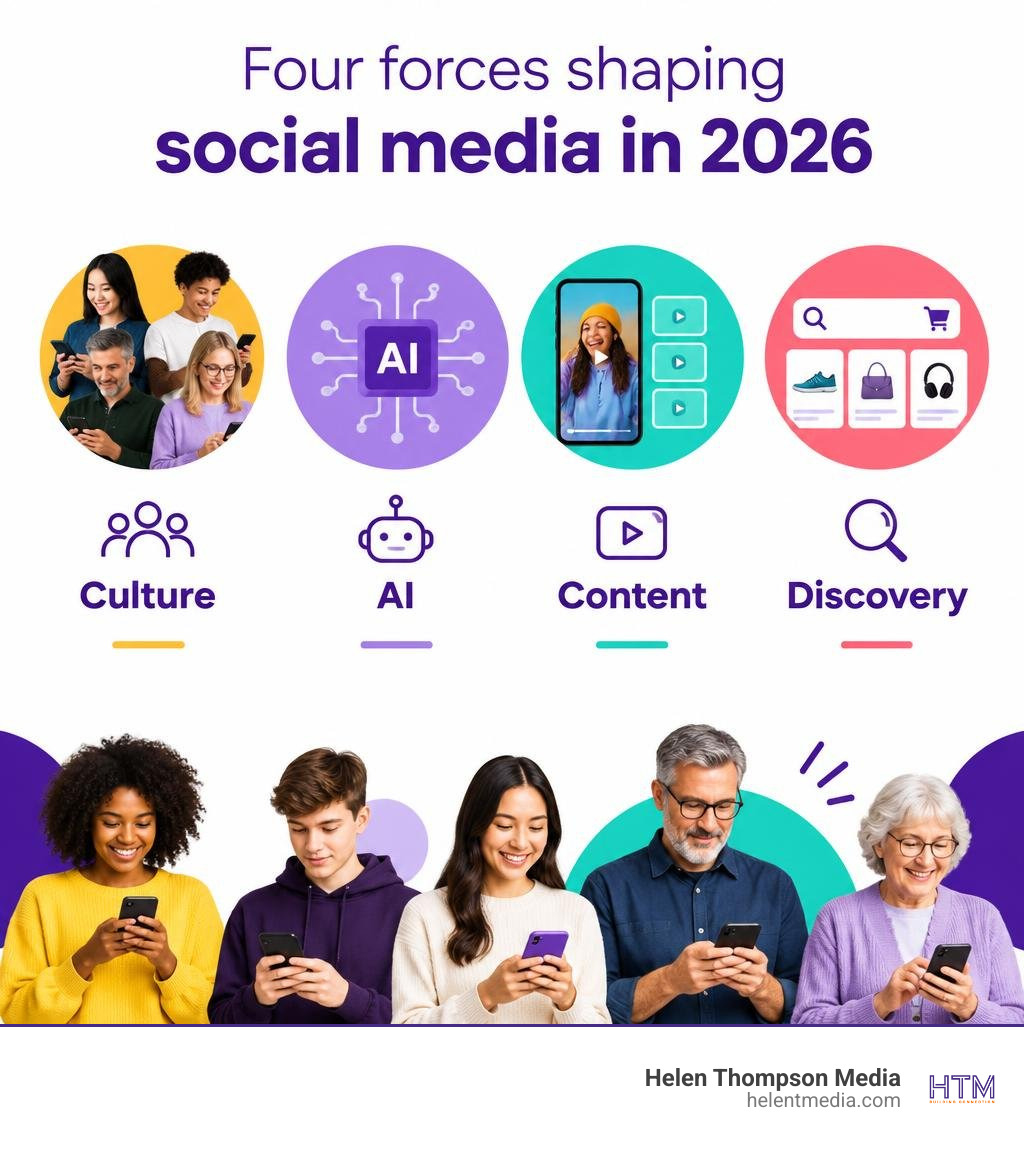
What current social media trends reveal about platform use in 2026
Before we talk about memes and micro-dramas, let’s look at where people actually spend their time. Pew Research Center’s Americans’ Use of Social Media in 2026 surveyed 5,511 U.S. adults between January and June 2026. Here is how it breaks down:
| Platform | U.S. adults using it in 2026 | Historical change |
|---|---|---|
| YouTube | 84% | Up from 73% in 2018 |
| 70% | Up from 54% in 2012 | |
| 51% | Up from 9% in 2012 | |
| TikTok | 37% | Up from 21% in 2021 |
| X | 18% | Down from 24% in 2018 |
The story is steady growth for the big video-friendly platforms and a slow fade for X. Instagram’s climb from 9% to 51% is remarkable. TikTok’s growth has leveled off at around 37% over 2025 and 2026, but it remains the platform where younger adults live.
Age matters a lot. Among adults 18 to 29, 95% use YouTube, 79% use Instagram, and 65% use TikTok. Among adults 65 and older, those numbers drop to 65%, 21%, and 11%. Facebook peaks among 30 to 49 year olds at 78%. Women are more likely to use Facebook, Instagram, TikTok, and Snapchat, while men lean toward X and Reddit.
The takeaway: no single platform reaches everyone. Hootsuite’s 2026 social media trends research makes a similar point, noting that attention is scarce and culture is fragmented by generation. That is why combining reach across platforms usually beats betting on one channel.
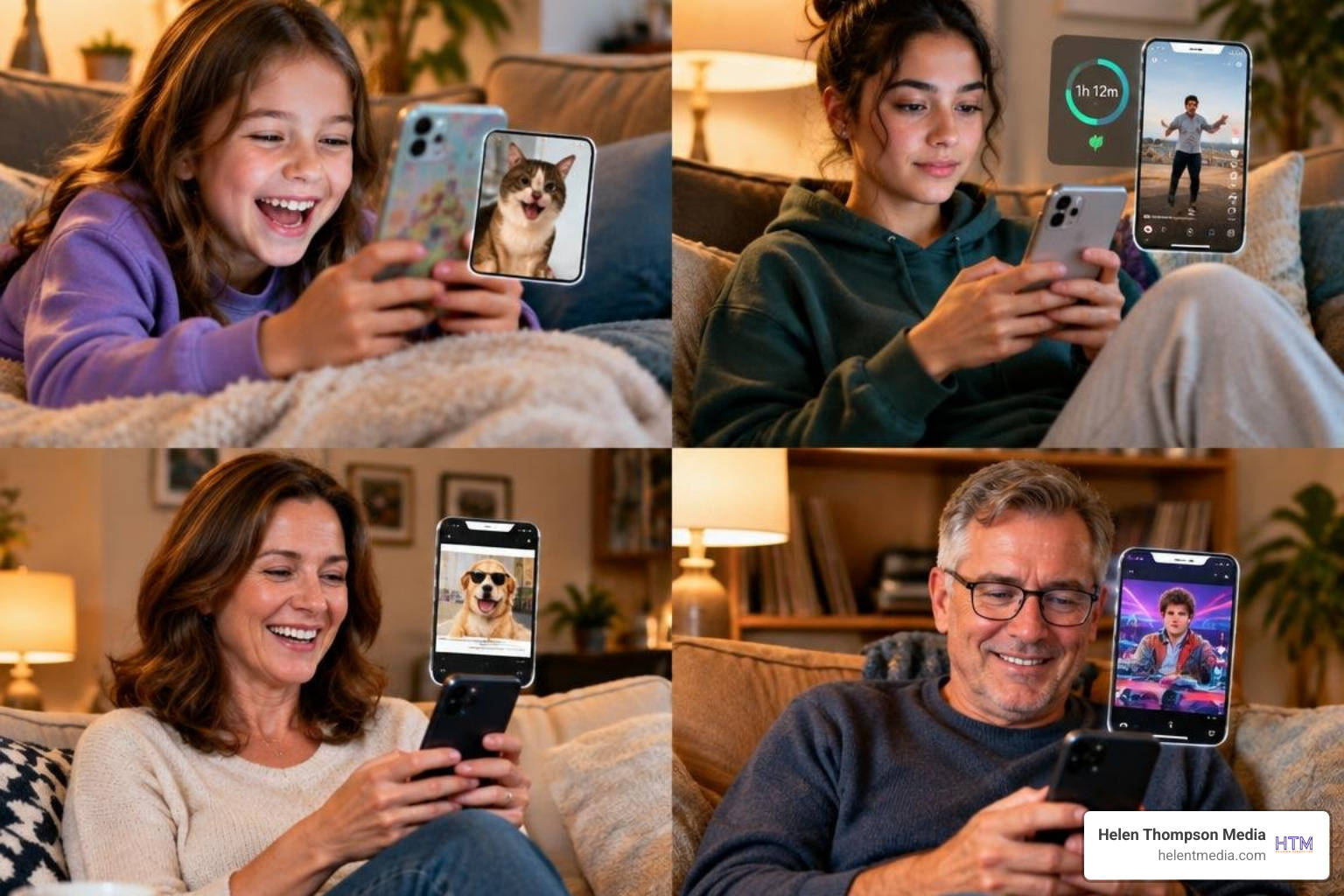
How current social media trends vary by generation
Generic content is the fastest way to bore everybody. Here is what each generation is leaning into.
- Gen Alpha: Chaos culture. Think absurdist, nonsensical humor, like the “67” memes taking over TikTok. If it makes adults say “I don’t get it,” it is probably working.
- Gen Z: Heavy TikTok users who also say they want less screen time. Digital wellbeing is a real theme, so content that respects their time lands better.
- Millennials: Relatable work-life balance humor. Instagram trends like “Born to… forced to…” and “Some bills are non-negotiable” are built on the gap between dream life and daily responsibilities.
- Gen X: Nostalgia for the 1970s and 1980s. This generation has the biggest wallets, so a throwback theme can be worth the effort.
- Everyone: Cozy aesthetics, frugal optimism, and slow living are a counterweight to overstimulation.
How AI, authenticity, and influence are reshaping social media marketing
AI is now table stakes. In 2025, AI-generated articles surpassed human-written ones online for the first time, and Ahrefs found that 87% of surveyed respondents used AI throughout content creation. AI also helps with predictive analytics, spotting patterns in engagement so you can plan a content calendar, and with rapid testing of hooks, captions, and formats.
But consumers are wary. Klaviyo reports that only 13% completely trust AI, and 36% somewhat trust it. Nearly a third of consumers say they are less likely to choose a brand that uses AI ads. When everyone can produce polished content in minutes, imperfection becomes the signal of a real person. Slight stumbles, natural pacing, and even the occasional typo read as human.
Influence is shifting too. Follower count and engagement rate are no longer reliable measures of impact. Storytelling quality, audience alignment, and return on investment matter more. Audiences also tend to trust employees more than influencers or CEOs, and 80% of consumers trust user-generated content more than traditional ads. For a closer comparison, see our look at UGC vs. influencer content.

Balancing AI tools with human-made content
A simple rule: let AI handle speed, and let people handle meaning.
- Use AI for efficiency: drafts, variations, caption ideas, and analysis.
- Keep human review: a person should check facts, tone, and quality before anything publishes.
- Protect brand voice: if a post could have come from any company, rewrite it.
- Be transparent: Sprout Social’s Social Media Trends 2026 report found 52% of social users are concerned about brands posting AI content without disclosure, and 46% are uncomfortable with AI influencers.
- Respect consent: collect first-party data openly, through lead forms, subscriptions, and DMs.
AI anxiety is real. Brands that show the humans behind the work earn more goodwill than those hiding behind automation.
Moving from one-off influencer posts to ongoing advocacy
Aspire reports that 74% of marketers planned to raise influencer budgets in 2026, but the smart money is moving from single posts to lasting relationships. Look for creators whose audience matches yours, not just whose numbers are biggest.
Employee advocacy and in-house creators are the other half of the shift. Staff can share expertise, show behind-the-scenes moments, and extend reach far beyond a brand page. Set up simple approval and governance steps so sharing stays easy. Pair this with customer UGC, and judge it all by saves, shares, leads, and conversions rather than vanity metrics.
How short-form video, micro-dramas, and Instagram formats earn attention
Short-form video is still king, but it is splitting in two. Reels, TikTok, and YouTube Shorts handle quick hits, while YouTube carries longer storytelling. Instagram Reels can now run up to 20 minutes, and TikTok videos can run up to 10.
The bigger shift is serialized content. Deloitte predicts micro-dramas, short episodic series made for social, will bring in $7.8 billion in 2026. Audiences follow people and recurring characters, not logos. A brand does not need a Hollywood budget. A workplace sitcom, a recurring “day in the life,” or a character-led how-to series builds the habit of coming back.
Keep the basics in mind:
- Hook viewers in the first two to three seconds, because retention and completion rate drive distribution.
- Edit natively for each platform instead of reposting the same file everywhere.
- Build repeatable formats and characters so each episode feeds the next.
Instagram trends and formats that can improve reach and engagement
Reels now account for 50% of time spent on Instagram and reach more than 2 billion people monthly, according to Meta. Here is what works:
- Reels for reach: they generate more than twice the reach of a static photo. Use unexpected camera angles and raw, unpolished footage.
- Carousels for saves and shares: ideal for tips, lists, and step-by-step guides.
- Strong hooks: speak to a specific audience instead of everyone.
- Keyword-rich captions: Instagram content is increasingly searchable, and Google has started indexing public posts.
- Behind-the-scenes and interactive reveals: formats like “The process vs. the product,” “Zoom in,” and tap-to-reveal invite interaction.
- Smart trend fit: audio trends peak in about 7 to 10 days, while format trends last 3 to 4 weeks. Join in the first few days, and skip trends that clash with your brand.
- Audio licensing: business accounts are limited to commercially licensed music, so check that a sound is licensed or marked “Original audio” before posting.
To see how performance compares, check our 2025 social media CTR benchmarks.
How social search, social commerce, and emerging platforms are changing discovery
People now search where they scroll. Adobe finds about half of consumers use TikTok as a search engine, and Sprout Social reports nearly one in three consumers skip Google to start on social, with more than half of Gen Z doing so. Meanwhile, answer engines summarize results directly, so clear how-tos, demos, and reviews have a better shot at being surfaced.
To optimize, write searchable captions, use plain-language keywords on screen and in spoken audio, and answer real customer questions. Think of it as social SEO plus answer engine optimization.
Shopping follows search. Statista counts 1.63 billion social buyers worldwide in 2026, and in-app checkout keeps shortening the path from discovery to purchase. Lead capture matters too. Tools such as instant forms on Meta and TikTok collect consent-based first-party data without sending people off the platform, which is increasingly valuable as third-party data fades.
Emerging platforms deserve small, careful experiments:
- LinkedIn: a younger audience and new video features make it a creative playground, not just a resume site.
- Substack: now has a feed, inbox, and profiles. It rewards consistent, high-quality long-form writing.
- Bluesky: users value genuine conversation over promotion.
- Threads: Meta says it passed X in monthly active users in October 2026.
Each has its own norms, so learn them first. It is better to do a few platforms well than many poorly.
How to turn current social media trends into measurable results
Trends are only useful if they move a business number. A simple approach:
- Research your audience: who they are, what they value, and where they spend time.
- Listen: use social listening to catch shifts early.
- Make platform-specific content: one idea, many native versions.
- Measure what matters: reach, qualified engagement, leads, conversion rate, and customer lifetime value.
- Test and learn: run small experiments, keep winners, drop the rest.
The best results come when social works alongside other channels. We explain why in Stronger Together: Why Integrated Digital Campaigns Drive Maximum Impact.
Frequently Asked Questions about current social media trends
Which social media platforms are most popular among U.S. adults in 2026?
YouTube leads at 84%, followed by Facebook at 70%, Instagram at 51%, and TikTok at 37%. Usage varies by age: 65% of adults 18 to 29 use TikTok versus 11% of those 65 and older. Over the long run, Instagram, YouTube, and Facebook have all grown, while X has declined.
How should brands use AI without losing consumer trust?
Keep humans in charge of review, brand voice, and final decisions. Be open about AI use, especially in customer-facing content, since many consumers worry about undisclosed AI. Use it to work faster, not to replace the real people your audience wants to see.
Which social media trends should a brand prioritize first?
Start with audience fit, then match trends to your resources, goals, and each platform’s norms. Choose one or two, such as short-form video or social search, and run measurable tests before expanding.
Conclusion
The big lessons for 2026 are simple. Know which generation you are talking to, use AI for speed while keeping content human, build series people want to follow, and make sure customers can find and buy from you. Choose only the trends that fit your brand, protect authenticity, and measure outcomes beyond likes.
At Helen Thompson Media, we have helped Texas and national brands grow since 1989 by connecting social with search, streaming TV, broadcast, radio, and out-of-home. If you want help turning trends into results, we would love to talk about an integrated advertising and media strategy built around your goals.