
Custom SEO Services Start With Your Business Goals
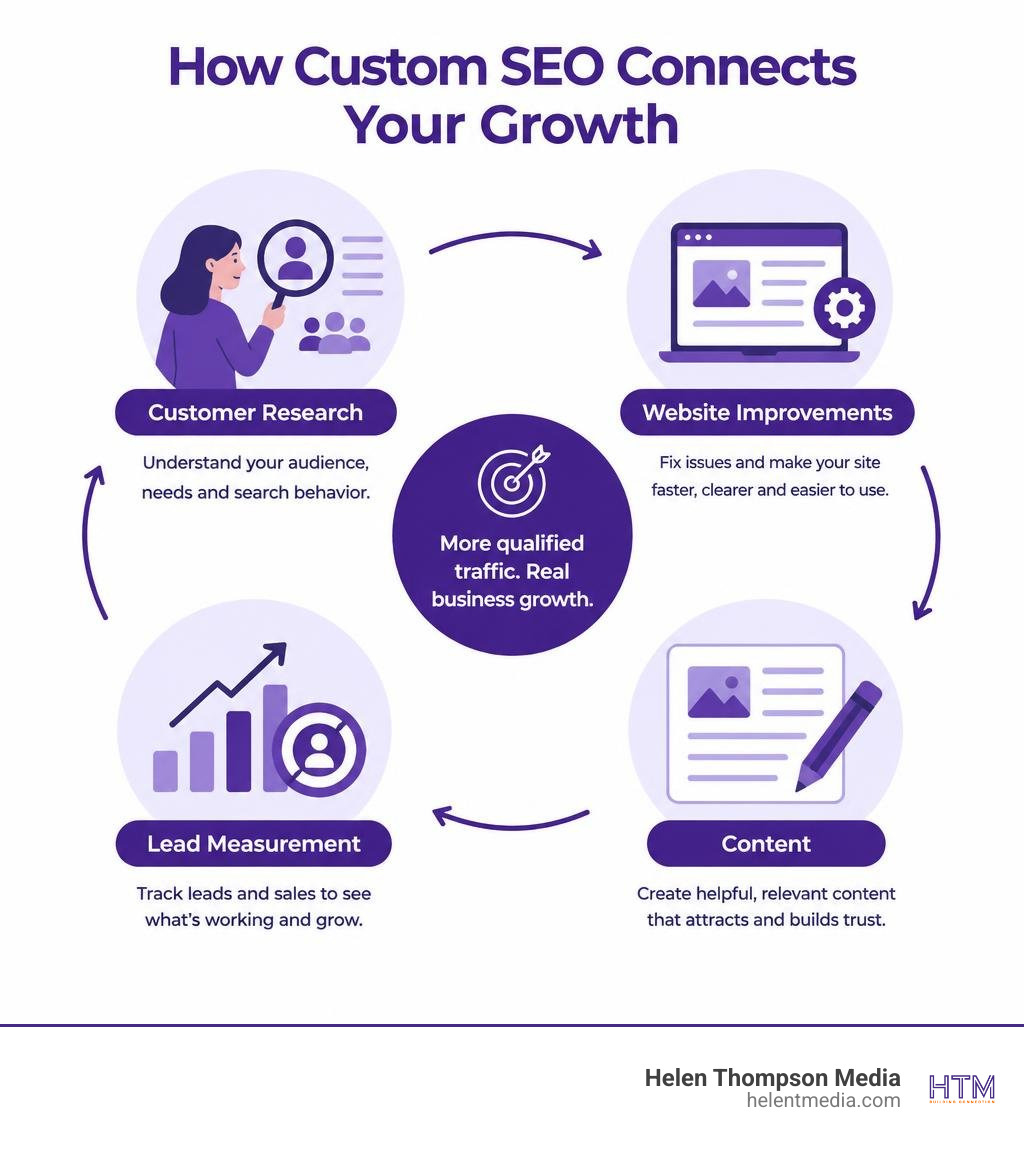
For small businesses, custom seo services are search strategies built around your customers, website, locations, and budget. Instead of giving every business the same tasks, a tailored plan starts with an audit, then puts the most useful work first: finding the searches that matter, fixing site issues, improving content, and tracking leads or sales.
That focus matters when you serve several Texas markets or run search alongside other campaigns. You can see which work supports real business goals, what it costs, and whether the proposed contract fits your needs.
I’m Brandon Thompson, President and Partner at Helen Thompson Media. Since 1999, I’ve worked across search and other media, experience that helps me place custom seo services within a broader plan for reaching customers and measuring results.
What custom SEO services include—and how they differ from generic packages
Custom SEO is a strategy and set of ongoing improvements shaped around a specific business. It considers your audience, services, geography, competition, website, and goals. A generic package, by contrast, may offer a fixed list of tasks regardless of whether those tasks address your site’s most important needs.
| Area | Custom SEO | Generic SEO package |
|---|---|---|
| Scope | Prioritized around your goals, website, and available resources | Usually a standard list of deliverables |
| Priorities | Based on audits, search intent, competition, and opportunity | Often similar across clients |
| Deliverables | Selected and adjusted as the campaign develops | Commonly fixed by tier |
| Reporting | Connected to leads, sales, and agreed goals | May emphasize activity or rankings |
A tailored plan does not automatically mean a larger or better campaign. A small business may need a focused technical cleanup or a few strong service pages, rather than every SEO task at once. Google’s SEO Starter Guide offers a useful overview of how search-friendly websites are organized and presented.
How custom SEO services are tailored to a small business
A useful strategy reflects the actual conditions of your business. For example, a local service company competing in a few nearby cities has different priorities from an online retailer selling nationwide.
A provider may consider:
- Business size, services, and growth targets
- Industry and the level of competition in search
- Service area, number of locations, and local demand
- Website platform, condition, and existing search performance
- Available budget and in-house marketing support
Those details help determine what to tackle first. If important pages are hard for search engines to access, technical work may take priority. If the site is healthy but lacks useful service information, content may be the better first investment.
Core components of a custom SEO package
The mix of work depends on the audit and objectives, but a package may include:
- Keyword and intent research: Identify the questions and searches relevant to your services, then map them to the right pages.
- Technical SEO: Review crawlability and indexing, broken links, redirects, site structure, structured data, and Core Web Vitals, which measure aspects of loading, responsiveness, and visual stability.
- On-page improvements: Refine page titles, headings, descriptions, internal links, and content so pages are clear to both visitors and search engines.
- Content creation and refreshes: Build or improve service pages, location pages, and helpful articles based on customer needs.
- Link building: Earn relevant links through valuable content and legitimate outreach, not purchased link schemes or other shortcuts.
- Local SEO: Improve local listings, business details, location content, and review processes where local visibility matters.
- Measurement: Set up analytics and conversion tracking to connect search activity with calls, inquiries, bookings, or sales.
Not every business needs all of these at the same intensity. The package should explain what is included, why it matters, and how progress will be assessed.
How tailored SEO supports credibility, reach, and business growth
Search visibility can help people discover a business while they are researching a need or comparing providers. But a high position alone does not create trust. Useful information, accurate business details, a secure and usable site, and evidence of real expertise all contribute to how people perceive a brand.
SEO can also help businesses reach customers at different stages of a decision. Informational content can answer early questions, while service pages can help people ready to contact a provider. Competitor research can reveal gaps in the market, but the goal should be to serve customers better, not simply copy another website.
Content marketing and PPC working together
SEO research can inform content marketing by showing what people ask, how they describe a problem, and what information they need before taking action. A set of connected pages, often called a topic cluster, can cover a core service and its related questions without forcing every search term onto one page.
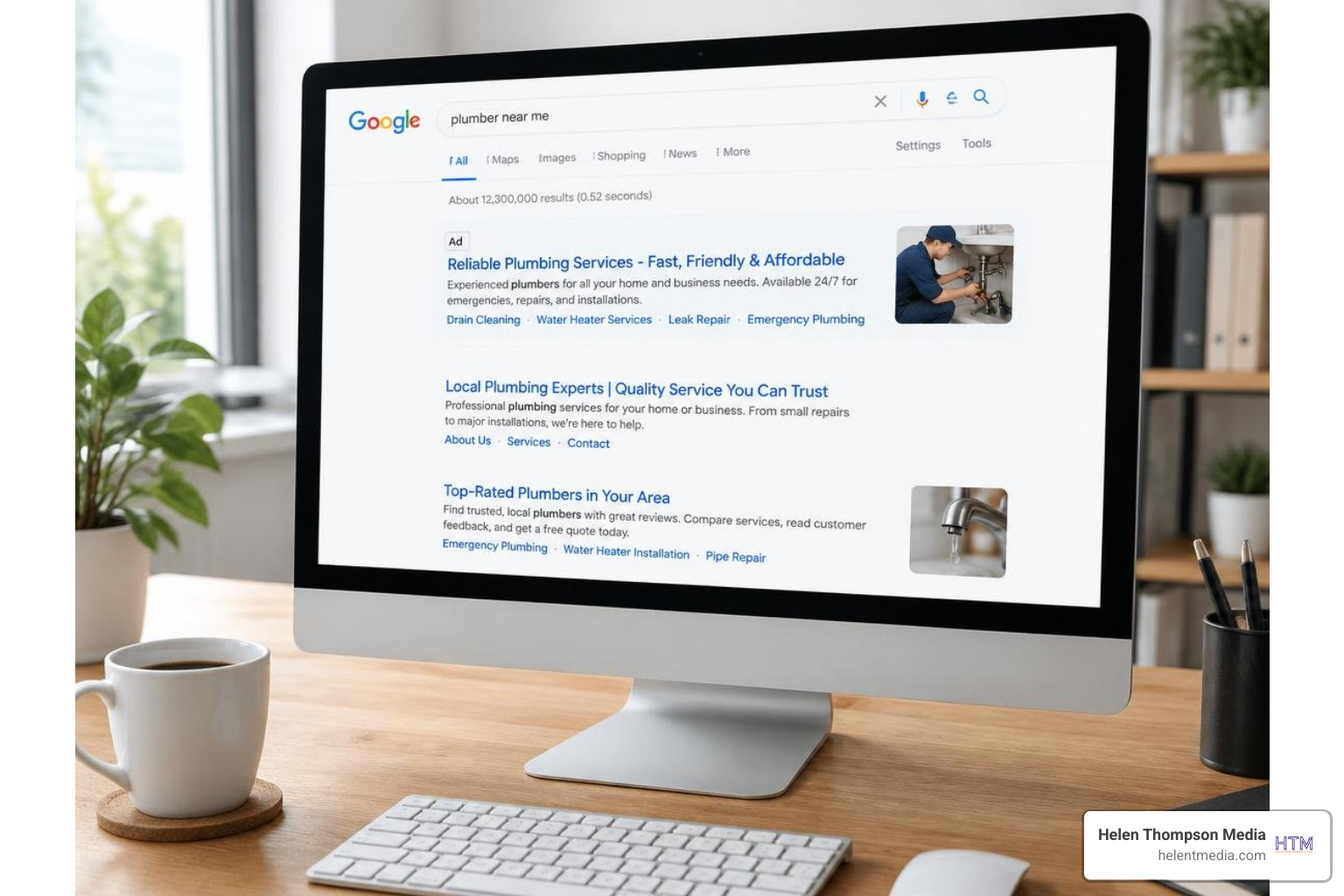
Paid search and organic SEO can support one another, too. Paid campaigns can test messaging and reveal which searches generate qualified inquiries. SEO can build useful landing pages and longer-term visibility for relevant topics. If a page performs well organically, its content and conversion data may offer ideas for paid campaigns. Conversely, paid search can provide immediate visibility while organic pages are still developing.
We coordinate search with broader digital advertising goals, and Google Ads campaigns can complement organic search when the targeting and landing pages are aligned. The channels should share insights, not compete for attention or budget without a plan.
Local rankings and website usability
For a business serving a defined area, local SEO helps connect nearby searches with accurate, useful information. Start by claiming and maintaining your Google Business Profile, then make sure your business name, address, phone number, hours, and services are correct. Encourage genuine customer reviews and respond professionally. Consistent details across relevant directories can also help people verify that they have found the right business.
Location pages can be useful when they provide real information about each area served. Avoid creating near-identical pages that simply swap city names; thin, repetitive pages rarely help customers choose you.
Local visibility and usability go together. A person searching on a phone may want to call, request directions, or book quickly. Pages should load well on mobile, make contact options easy to find, and use straightforward navigation. Fast loading and accessible content help visitors use the site, not just search engines process it.

Timelines, pricing, and contract options for custom SEO
Custom SEO can be delivered as a defined project, a one-time audit, or ongoing work. The right structure depends on whether you need a diagnosis, a specific set of changes, or sustained support.
| Engagement type | Typical scope | Duration and use |
|---|---|---|
| One-time audit | Review of technical health, content, search visibility, and prioritized recommendations | A defined project; useful for identifying issues or planning in-house work |
| Project pricing | A specific set of tasks, such as improving key pages or addressing a technical issue | Agreed scope and schedule; useful when needs are clear and limited |
| Monthly retainer | Ongoing strategy, implementation, content, monitoring, and reporting | Month to month or for an agreed term; useful when the site needs continuing work |
Pricing depends on scope. Some managed SEO engagements begin around $2,000 per month, while smaller projects or limited audits may be priced differently. Treat any figure as a starting point, not a universal rate. Ask for a written scope that explains the work, fees, timing, and what happens if priorities change.
A no-long-term-commitment arrangement can provide flexibility, but it should still include clear expectations. Confirm notice periods, cancellation terms, access to accounts, and ownership of content and other campaign assets before signing.
When to expect measurable SEO results
SEO does not produce the same timeline for every site. Technical fixes may resolve access or indexing problems relatively quickly, but search engines need time to process changes, and stronger rankings depend on competition, content quality, and authority.
A practical plan sets a baseline, then tracks progress through stages: first, site health and implementation; next, ranking movement and relevant organic visits; and ultimately, qualified leads, sales, or other conversions. Many campaigns need three to six months to show meaningful movement, while building durable visibility in a competitive market can take 12 to 18 months. These are planning ranges, not promises.
Seasonality can also affect results. A business may naturally receive more searches during certain months, so compare performance with relevant previous periods where possible. Rankings and traffic are useful indicators, but business outcomes should remain the focus.
What influences the cost of SEO
The main cost drivers include:
- Website size and the number of pages needing work
- Market difficulty and the strength of competing sites
- The number of locations and local markets covered
- The volume and expertise required for new or refreshed content
- Technical complexity, including platform or migration issues
- The time needed for legitimate link earning and outreach
- Reporting, analytics, and conversion-tracking requirements
- The level of support available from your in-house team
- Changes to scope or priorities during the campaign
A provider should explain how the proposed work relates to these factors. If the budget is limited, ask what can be phased, what your team can implement, and which tasks are most likely to address the biggest barriers.
How to choose a provider and measure campaign performance
A good provider can explain the reasoning behind the strategy in plain language. Look for a clear audit process, realistic expectations, ethical methods, and reporting that connects work to business goals. Avoid proposals built around guaranteed rankings or large quantities of links without a credible explanation of quality and relevance.
Questions to ask before signing
Before choosing a provider, ask:
- What will the initial audit cover, and how will findings shape priorities?
- Which tasks are included, and which would cost extra?
- How often will we receive reports, and who will explain them?
- How will you track calls, leads, sales, and assisted conversions?
- What context can you provide for case studies, including timeframe and starting conditions?
- Who will do the work, and how will we communicate?
- What are the contract length, cancellation terms, and renewal process?
- Do we retain access to our website, analytics, content, and other accounts?
- Can you guarantee a first-page position? A responsible provider should explain why no one can control search rankings.
- How would you investigate a sudden traffic loss or a Google manual action?
The answers should be specific to your situation, not a string of impressive-sounding promises. We bring search into a wider marketing plan through our services, with senior strategy and measurement across channels.
Metrics that connect SEO to business outcomes
Track a mix of leading indicators and results. Qualified organic traffic shows whether the site is attracting relevant visitors. Leads, sales, revenue, and conversion rate show whether that visibility is useful. Rankings can help diagnose progress, while crawl health and indexing checks show whether search engines can access key pages.
Assisted conversions matter as well: a person may discover your business through organic search, then return through another channel before converting. Looking at the full journey gives a more complete picture than crediting every sale to its last click. We use reporting to identify what is working and refine the plan, rather than treating a monthly ranking report as the finish line. Our articles and insights explore broader marketing considerations that can inform that work.
How custom SEO services adapt to AI search and generative answers
Search results increasingly include AI-generated summaries and answer formats. Generative engine optimization (GEO) and answer engine optimization (AEO) describe efforts to make information easier for search systems and AI tools to understand, assess, and potentially cite. There is no reliable shortcut or guaranteed placement in an AI-generated answer.
The fundamentals remain practical: publish accurate, original information; make expertise and authorship clear; organize pages with descriptive headings; and answer important questions directly. Structured data can help describe a page or business, but it does not guarantee enhanced results or citations.
Businesses can also monitor where their brand appears in search and AI answers, while recognizing that results may vary by query, location, and user. This is an evolving area, so strategy should be tested and updated rather than sold as a one-time fix. The relationship between automation and advertising is also changing; our perspective on AI and Google Ads strategy considers one part of that broader shift.
Frequently Asked Questions about Custom SEO Services
Can a small business start with an SEO audit instead of a monthly package?
Yes. A standalone audit can identify technical problems, content gaps, and opportunities, then rank recommended fixes by importance. It can be a sensible starting point if you have a limited budget or an in-house team that can carry out the work. Before commissioning one, confirm whether the provider will explain findings and help your team understand what to do next.
Are guaranteed first-page rankings a reliable provider promise?
No. Search engines control ranking systems, and results can change with competition, user needs, and algorithm updates. A provider can commit to the work, explain its methods, and report measurable progress, but a guaranteed position is not a credible promise. Focus on qualified traffic, conversions, and sustainable improvements.
Can SEO and PPC share data and support the same campaign?
Yes. Paid search can provide insight into queries, ad messaging, and landing-page performance. SEO can build relevant pages and organic visibility around customer needs. Reviewing both channels together helps teams understand which searches attract useful visits and where a page or message may need improvement.
Conclusion
Custom SEO should start with your business goals, not a preset checklist. A focused audit, a prioritized scope, realistic timelines, and transparent measurement can help small businesses invest in the work that matters most. Choose an engagement that fits your budget and offers clear terms, whether that means a one-time project or ongoing support.
At Helen Thompson Media, we connect search with a broader view of how customers encounter a brand across media. If you are planning your next stage of growth, we can discuss an integrated advertising and media strategy built around your goals.