
What a full service advertising agency should do
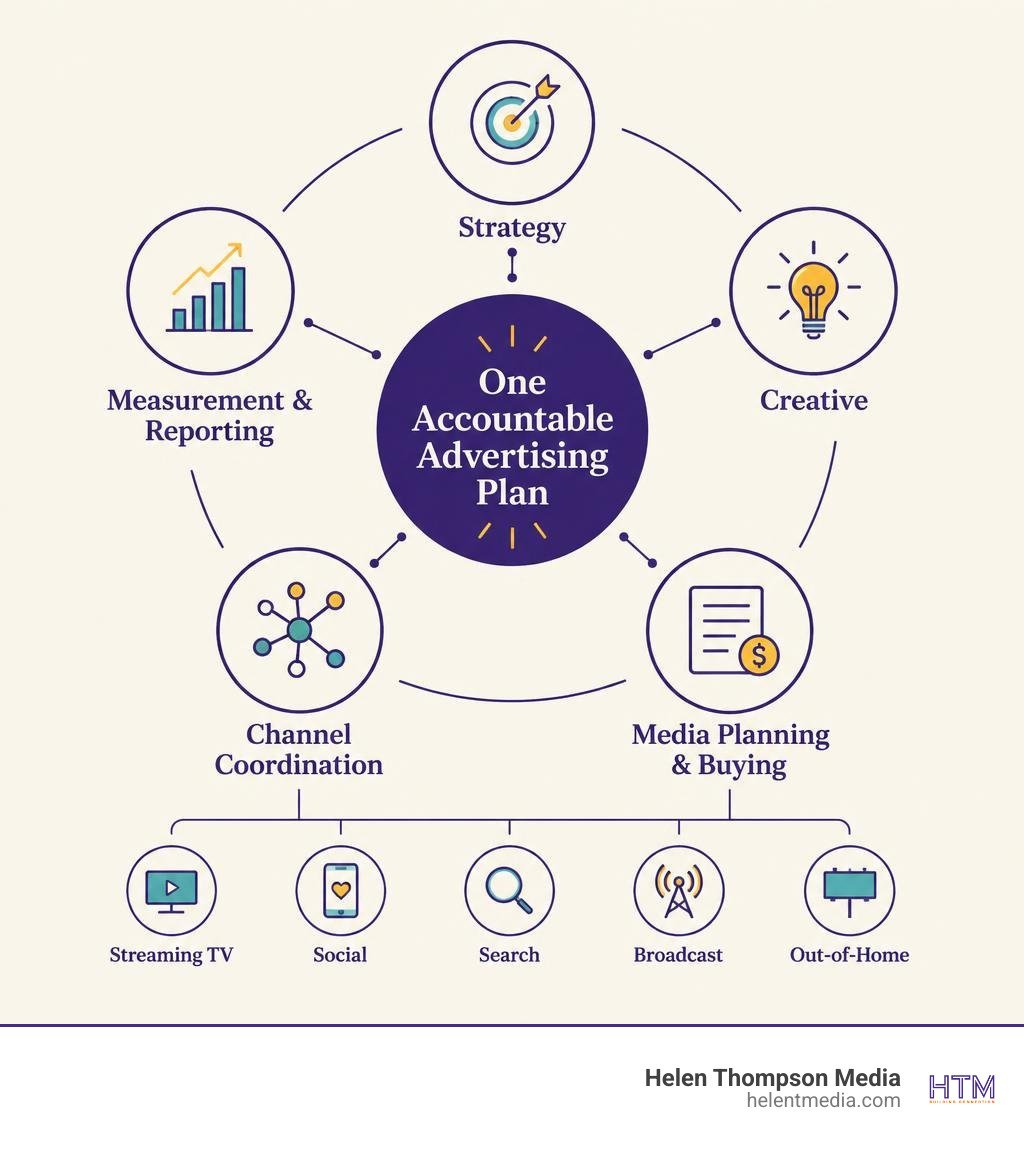
A full service advertising agency should plan, place, and measure your advertising as one campaign. For a multi-location brand, that means streaming TV, social, search, broadcast, and out-of-home should share clear goals, a consistent message, and a way to track results.
When you compare agencies, ask who sets the strategy, how channels work together, and what reports will show you. A single point of contact helps, but one accountable plan matters more.
I’m Brandon Thompson, President and Partner at Helen Thompson Media. I started here as a media planner and buyer in 1999, and today I guide integrated media strategy for Texas and national brands—experience I draw on when explaining what to expect from a full service advertising agency.
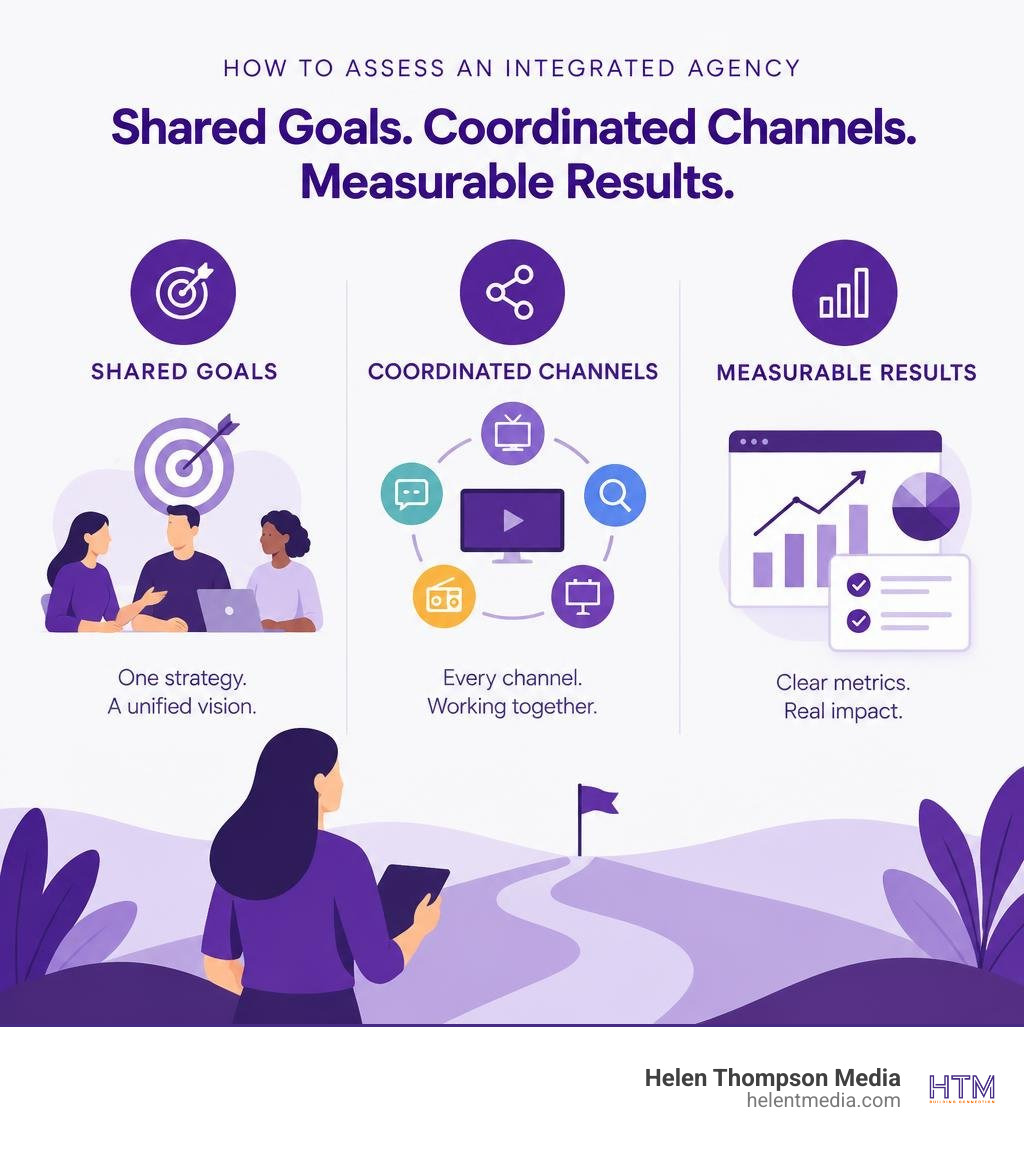
In plain terms, an advertising agency is a business hired to create, plan, and handle advertising for clients. The full-service kind does it all under one roof. The U.S. agency market passed $380 billion in 2024 and is expected to reach about $424 billion by 2027, so there is no shortage of options. This guide helps you sort them out.
What a full service advertising agency should deliver
Think of the agency as your outsourced marketing department. You get strategy, media buying, and ad creation without hiring every creative professional yourself. At a minimum, we believe you should expect these seven capabilities:
- Audience research: who buys, where they live, and what they watch, scroll, and search.
- Brand strategy: positioning that tells people why you are different.
- Creative development: concepts, copy, and design that break through clutter.
- Media planning: choosing channels, timing, and budget splits.
- Media buying: negotiating rates and run times, and placing the ads.
- Campaign production: scripts, storyboards, filming, editing, and finished assets.
- Performance analysis: reports that connect spending to results.
If an agency skips the last one, you are paying for hope. Our agency services cover all seven, so nothing gets dropped between teams.
What a full-service advertising agency does across channels
Each channel has a job, and a good agency assigns it deliberately:
- Search advertising: catches people already looking. Our Google search campaigns put you in front of them at the moment of intent.
- Paid social: builds awareness and engagement with precise targeting.
- Mobile: reaches people on the device they never put down.
- Streaming TV: delivers TV-style video with digital targeting. See our streaming TV campaigns.
- Broadcast TV and radio: still unmatched for broad reach and local trust.
- Out-of-home: billboards, panels, and signs that work while people commute.
Our digital advertising work ties the online pieces together, so a viewer who sees your streaming spot can later meet you in search or social with the same message.
The people and skills behind an integrated campaign
A full-service agency is really a team sport. Typical roles include:
- Account executives who manage the client relationship.
- Account planners and strategists who bring research and insight. Research on agency-client relationships suggests involved, senior, empathetic planners help partnerships work.
- Copywriters and art directors who make the ideas.
- Media planners and buyers who decide where ads run and negotiate the price.
- Producers who handle radio and TV spots.
- Social media managers who run calendars and community.
- Analysts who turn data into decisions.
The skills that matter most are communication, project management, and creative problem-solving. Add media literacy, and you have someone who can thrive in this world.
How a full-service advertising agency builds and measures an integrated campaign

Here is the typical path, from first call to final report:

- Client brief: goals, products, budget, and timing.
- Market research: demographics, competitors, and positioning, before anything is produced.
- Audience targeting and objectives: for example, store visits, leads, or sales.
- Budget and creative brief: the budget is split across channels, and the brief guides the creative team.
- Storyboard and production: scripts and storyboards plan a TV ad before anyone films it.
- Placement: ads go live across the chosen channels.
- Attribution and ROI: results are tied back to the business goal.
Social deserves its own planning. A social media planning calendar sets post frequency, format, and brand voice, and engagement data shows what to repeat.
How a full-service advertising agency connects ATL, BTL and TTL
Agencies often describe their work in three models:
- Above the line (ATL): large-scale, broad-audience advertising such as TV, radio, newspaper, and billboards.
- Below the line (BTL): targeted work for a focused group, such as paid search, events, social, and content marketing.
- Through the line (TTL): a blend of both, like TV commercials that send viewers to a search landing page, or email follow-ups to a social contest.
The magic is the handoff. Broadcast builds reach, targeted search captures demand, social creates engagement, and events and email nurture it. A consistent brand message ties it all together. Our traditional media planning and buying handles the ATL side with the same rigor as the digital side.
How the agency optimizes results after launch
Launch day is the starting line. After that, we watch:
- Reach and frequency: are enough of the right people seeing the ad, without tiring of it?
- Conversions: calls, form fills, visits, and sales.
- Engagement: clicks, views, comments, and shares.
Regular media reports feed testing of creative, audiences, and offers. When one channel outperforms, budget moves there. In 2026, AI-driven predictive media planning helps forecast where spend will work best, and generative engine optimization (GEO) helps brands show up in AI-powered answers. Technology helps, but senior judgment decides what to do with it.
How to compare and choose a full-service agency

Agencies come in several types. Here is how they compare:
| Agency type | Scope | Strengths | Trade-offs | Best fit |
|---|---|---|---|---|
| Full-service | Strategy, creative, media, production, analytics | One team, integrated accountability | May be less specialized in any one niche | Brands running many channels |
| Creative boutique | Concepts and design | Standout ideas | Needs separate media help | Brands needing a fresh identity |
| Media buying | Planning and placement | Buying power and rates | Little creative work | Brands with finished creative |
| Interactive | Digital, web, and online | Technical depth | Limited traditional reach | Digital-first brands |
| In-house | Internal team | Brand knowledge, control | Hiring costs, narrower perspective | Large, steady advertisers |
The full-service case is simple: one point of contact and integrated accountability. The downside is that specialists may go deeper in a single craft, and a larger scope can bring coordination costs. Weigh both honestly.
Money matters too. Agencies are typically paid through media commissions (often around 15% historically), fixed project fees, or monthly retainers. Ask which model applies and what it covers.
Location can matter as well. If you sell in San Antonio or across Texas markets, an agency that knows local media, audiences, and pricing has a real edge. Beyond skills, look for shared objectives and trust. Research on agency-client relationships points to shared purpose, mutual respect, personal chemistry, and equal status, rather than an agency simply taking the lead. Our agency experience shows how we have worked this way since 1989.
Questions to ask before hiring an agency
- What experience do you have in my industry?
- Who will do the senior strategy, and will I meet them regularly?
- Which channels can you handle in-house, and which do you outsource?
- What is your measurement plan, and how will you prove ROI?
- How often will I get reports?
- Who is on my team, and who is my day-to-day contact?
- How transparent are your fees?
- Can I see case studies and speak with references?
- Do we click? Chemistry counts over years of work.
When you are ready to talk, contact the agency and put us through these questions.
Advertising careers, agency history and industry outlook
Agencies are also a great place to build a career. Entry points include assistant account manager and junior social media associate. An internship helps, though it is not the only route. Build a portfolio, and a communications, marketing, advertising, or business degree is a common starting point.
The history is worth a quick look. The first acknowledged agency was William Taylor in London in 1786. Volney B. Palmer opened the first American agency in Philadelphia in 1850. In 1869, Francis Ayer created N.W. Ayer & Son, regarded as the first full-service agency, at just 20 years old. Later, James Walter Thompson hired writers and artists to form the first Creative Department. The industry has since moved through digital transformation and now AI adoption.
Common agency jobs, qualifications and salary outlook
Common jobs include account manager, account planner, copywriter, art director, media planner, media buyer, producer, social media manager, public relations manager, and marketing manager. Most entry-level jobs want a bachelor’s degree plus communication, project management, creative, and media skills.
Pay varies by role. According to U.S. Bureau of Labor Statistics figures, average annual pay is:
- Advertising, promotions, and marketing managers: $156,580
- Public relations managers: $132,870
- Art directors: $111,040
- Market research analysts: $75,950
- Writers: $72,270
- Graphic designers: $61,300
The advertising and marketing manager career outlook projects 8% employment growth from 2023 to 2033. For other roles, see the wage data for advertising occupations.
How agency work and business models have changed
Agencies began as agents for media, earning commissions for selling space. From the mid-19th century they started charging clients directly for services like copywriting, which led to the full-service model. Today, fees mix client-service charges, fixed project fees, and monthly retainers.
Globalization pushed agencies overseas in the 20th century, and consolidation produced giant holding groups. Consulting firms then entered the field with a data analytics emphasis and disrupted old models.
Meanwhile, digital media, streaming, and mobile changed where audiences are. Data analytics, generative AI, and predictive planning now make outcomes easier to measure. Clients expect proof, not just pretty ads.
Frequently asked questions about full-service advertising agencies
What services does a full-service advertising agency provide?
It handles strategy, creative, media planning, production, placement, and analytics across channels like search, social, streaming, broadcast, radio, mobile, and out-of-home.
How does a full-service agency differ from a specialist agency?
A specialist focuses on a few core services, such as creative or media buying, and brings deep expertise. A full-service agency integrates those services, which improves coordination and accountability, though you may trade some niche depth.
How do advertising agencies get paid, and how can I start a career in one?
Agencies earn media commissions (often around 15%), project fees, and monthly retainers. To start a career, earn a relevant degree, complete an internship, build a portfolio, and apply for entry-level roles such as assistant account manager.
Conclusion
The best agencies make advertising feel like one story rather than six disconnected ads. Integrated advertising, with clear strategy and honest reporting, is how brands see measurable growth. At Helen Thompson Media, we have brought San Antonio expertise and senior-level thinking to Texas and national brands since 1989. If you are ready for a partner who unites streaming, social, search, and broadcast, explore integrated advertising services with us today.