
How to decide if Pluto TV advertising fits your plan
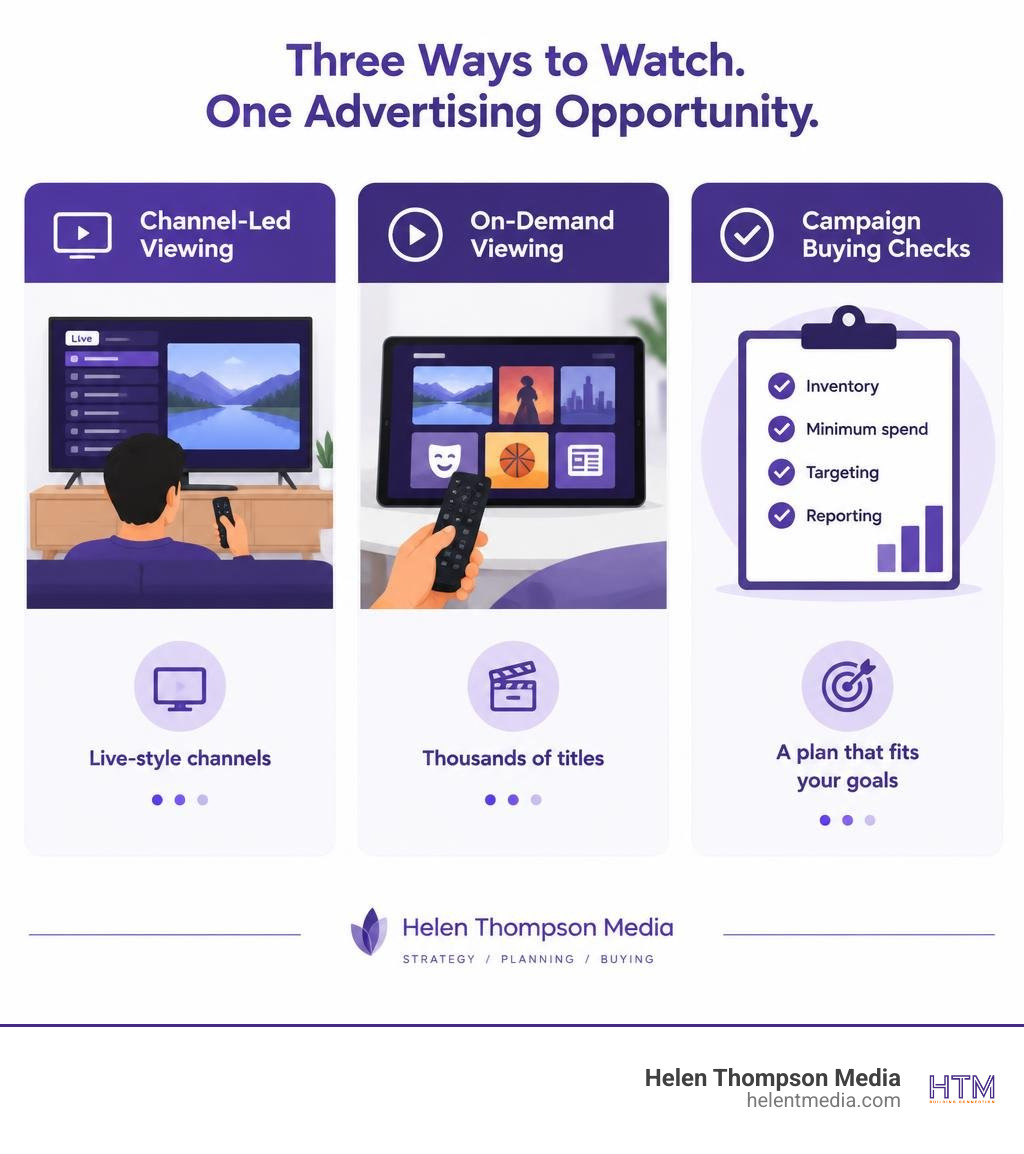
Start with your goal and market. To test Pluto TV advertising, ask for available inventory in the places you want to reach, then confirm the minimum spend, targeting, and reporting before you buy. Compare that plan with Tubi and The Roku Channel. Pluto TV is built around live-style channels, while Tubi puts more weight on on-demand viewing. The best fit depends on who you need to reach and what you can measure, not just the quoted CPM.
I’m Brandon Thompson, president and partner at Helen Thompson Media, where I’ve planned and bought media since 1999. My work across streaming TV, broadcast, search, and social informs how I evaluate Pluto TV advertising as part of a wider media plan.
How Pluto TV’s free model, audience, and ad load work
Pluto TV operates as a pioneer in the free ad-supported streaming TV (FAST) space. Unlike subscription platforms that require recurring fees, Pluto TV is 100% free for viewers. There is no account sign-up, credit card entry, or password wall required to start watching.
Viewers get access to over 425 live digital channels structured like a traditional cable electronic program guide (EPG), alongside thousands of on-demand titles across movies, crime, comedy, news, sports, and classic television. Because there is no ad-free premium tier, every single viewer on the platform is exposed to ads.
As subscription fatigue pushes viewers away from rising monthly bills—with ad-free plan prices jumping across major streamers—free platforms have seen substantial growth. Pluto TV reaches 68.8 million viewers in the United States and surpassed 80 million monthly active users globally.
Pluto TV’s high ad load supports its free access. Pluto TV runs nearly 13 minutes of commercials per hour across its live streaming channels, representing the heaviest commercial load among tracked free services. In tests of full-length movies, ad breaks averaged around 30 minutes in total—roughly double the ad volume of on-demand free rivals like Tubi.
Because these ad breaks occur in non-skippable mid-roll and pre-roll positions within scheduled programming, viewers experience a familiar broadcast rhythm. For media buyers investing in Streaming TV, this environment provides high message completion, provided the campaign accounts for viewer habits. While digital channels proliferate, linear-style TV viewing habits remain central to how audiences consume entertainment on their home screens.
Who watches Pluto TV, and what can advertisers reach?
Pluto TV draws a distinct, highly engaged audience across several demographic groups:
- Age Profile: 50% of the audience is between 18 and 34 years old, offering substantial reach into younger millennial and Gen Z demographics who rarely buy traditional cable packages. The remaining half is balanced across the 35–64 age group.
- Gender Breakdown: Viewership sits at approximately 58% male and 42% female.
- Household Economics: Pluto TV indexes well with value-conscious and middle-to-lower-income households who prioritize zero-cost entertainment options.
- Device Mix: Viewers access content predominantly on big-screen Connected TVs (smart TVs, streaming sticks, gaming consoles), with secondary viewing taking place on mobile apps and desktop web browsers.
- Contextual Environment: Viewers intentionally lean into specific genres—from niche pop-up marathons to 24/7 news, sitcoms, and true crime.
Pluto TV advertising formats, costs, and buying options

Pluto TV delivers ad experiences that mirror broadcast commercial breaks while adding modern digital delivery controls. Inventory across the service spans several core formats:
- In-Stream Mid-Roll Video: Standard 15- and 30-second non-skippable ads that play during natural breaks within live linear channels and on-demand titles. This format accounts for the bulk of video inventory.
- Pre-Roll Video Ads: Short, non-skippable commercials that play immediately before an on-demand movie or show starts.
- Display and Home Screen Banners: High-impact banners placed within the app guide and discovery menus.
- Curated Channel Sponsorships: Direct takeovers and branded slate placements aligned with specific themed channels or seasonal programming.
When developing creative assets, businesses must ensure that technical specifications match industry guidelines and adhere to Paramount’s advertising rules. Creative assets are subject to strict review to ensure broadcast-quality resolution, sound leveling, and content compliance before entering the active ad server. When orchestrated alongside a broader Digital Advertising mix, these streaming formats build strong top-of-funnel reach that feeds search and social engagement.
How much does Pluto TV advertising cost?
Pluto TV pricing provides an accessible entry point compared to subscription streaming tiers:
- Programmatic and Self-Serve CPMs: Costs typically range from $15 to $25 CPM (cost per thousand impressions). By comparison, subscription-based ad tiers like Netflix ($37+ CPM) or Hulu ($25–$40 CPM) command higher rates.
- Direct-Buy Investment: Securing guaranteed placements or channel sponsorships directly through Paramount’s sales team usually requires minimum spend commitments starting at $25,000+.
- Targeting Premiums: Applying tight parameters (such as narrow ZIP-code clusters, strict dayparting, or niche third-party behavioral segments) adds variable premiums to base CPMs.
- Small-Business Budgets: Through automated platforms and self-serve dashboards, local advertisers can test campaigns with monthly spends ranging between $200 and $500.
How to buy Pluto TV advertising directly, programmatically, or through self-serve options
Media buyers have several distinct routes to secure Pluto TV inventory:
- Paramount Direct: Enterprise-level media buying directly through Paramount’s national ad sales team. This route provides guaranteed delivery, exclusive channel sponsorships, and custom integrations.
- Paramount Ads Manager: Paramount’s self-serve platform that opens up access to Pluto TV, CBS, and Paramount+ inventory with flexible entry budgets.
- Programmatic via DSPs: Agencies access Pluto TV supply programmatically through major demand-side platforms (DSPs) via private marketplace (PMP) deals or open real-time bidding (RTB).
- Bundled Multi-Channel Platforms: Small-to-midsize businesses can buy aggregated CTV packages that distribute impressions across Pluto TV and complementary free ad-supported networks.
Building sustainable brand awareness requires combining reach across platforms, ensuring your streaming TV placements reinforce what potential customers see on search and social channels.
Targeting, measurement, restrictions, and campaign challenges

What targeting and measurement options are available?
Pluto TV advertising campaigns support modern digital targeting layers:
- Geographic Targeting: Pinpoint audiences by Designated Market Area (DMA), state, city, or specific ZIP codes.
- Contextual and Genre Targeting: Align ads with content environments such as Live News, Sports, Comedy, Drama, True Crime, or Anime.
- Dayparting: Schedule ad delivery during key time windows (such as morning news, primetime, or late night).
- Device Segmentation: Target users viewing on Connected TVs, mobile devices, tablets, or desktop browsers.
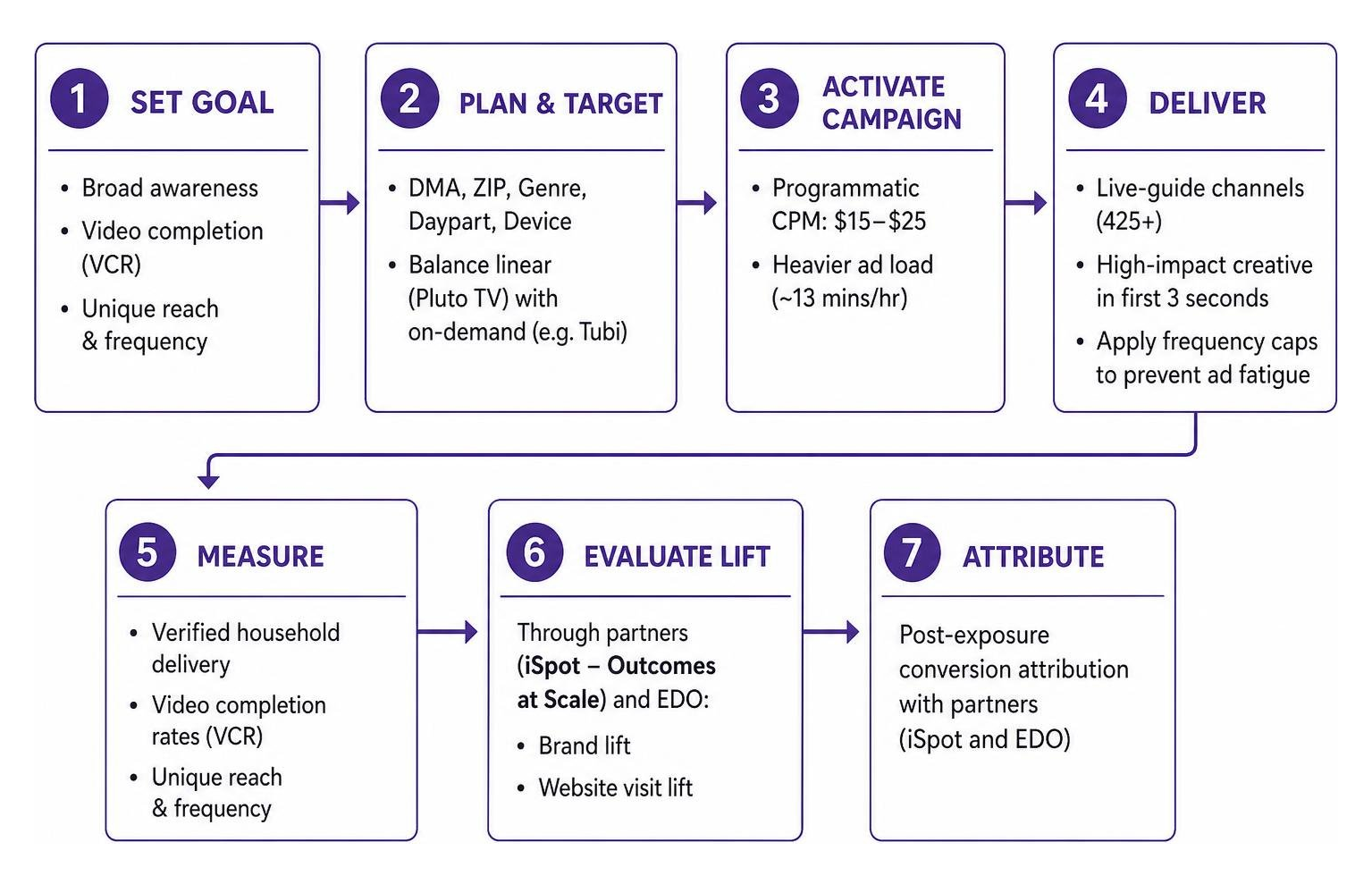
- Measurement and Verification: Campaigns track verified household delivery, video completion rates (VCR), and unique reach/frequency. Through partners like iSpot (Outcomes at Scale) and EDO, advertisers can evaluate brand lift, website visit lift, and post-exposure conversion attribution.
Which advertising categories and practices may be restricted?
Paramount enforces comprehensive standards across Pluto TV inventory. According to official guidelines, several advertising categories are restricted or outright prohibited without advance written clearance:
- Adult, obscene, and salacious content
- Illegal drugs, paraphernalia, tobacco, and e-cigarettes
- Firearms and weapons
- Distilled liquor (some beer/wine allowed with conditions)
- Unregulated dietary supplements and weight-loss products
- Gambling, sports betting, and political/advocacy messaging without pre-clearance
- Advertisements promoting copyright infringement or copy-protection circumvention
- Competitive Services: Ads promoting competing broadcast, cable, news, or streaming networks (including platforms from Disney, NBCUniversal, Warner Bros. Discovery, or Fox) are prohibited.
Additionally, programmatic inventory is governed by run-of-service, blind-selling protocols where bidstream identifiers may be obfuscated. Advertisers placed on Pluto’s internal Block List must be removed by partners within specified operating timelines (usually within 24 to 48 hours of notification).
Navigating these guidelines is essential as the FAST market fragmentation continues to distribute viewers across competing platforms.
How Pluto compares with other free-streaming models—and how to plan a campaign
| Feature / Metric | Pluto TV | Tubi | The Roku Channel |
|---|---|---|---|
| Primary Viewing Style | Linear, live-guide channels (425+) | On-demand catalog & movies | Hybrid (Roku OS integration & Live Guide) |
| US Viewership Reach | ~68.8 Million | ~92.5 Million | ~97.3 Million |
| Average Ad Load | ~13 mins/hr (Heaviest FAST load) | ~6–8 mins/hr | ~8–10 mins/hr |
| Average Programmatic CPM | $15 – $25 | $18 – $30 | $18 – $28 |
| Targeting Precision | DMA, ZIP, Genre, Daypart, Device | Contextual, Genre, Behavioral, Demo | Roku First-Party Data, Household IDs |
| Best Campaign Use Case | Broad awareness, cable-style frequency | Intentional movie/show viewing | Broad ecosystem reach & device home-screen takeovers |
When planning a multi-platform strategy, consider these practical steps:
- Address Ad Fatigue: Because Pluto TV has a heavier ad load, set strict frequency caps at the DSP or campaign level to prevent viewers from seeing your commercial on every break.
- Account for Channel Surfing: Lean-back viewers flip channels during commercial breaks. Use high-impact visual branding and clear audio cues in the first 3 seconds of your creative.
- Balance Context: Blend Pluto TV’s live channel environment with on-demand streaming buys to catch both passive channel surfers and active on-demand searchers.
When does Pluto TV make sense for a small business?
Pluto TV is a viable CTV option for local businesses when deployed strategically. A local automotive dealer, home services contractor, or regional healthcare provider can buy inventory filtered strictly to their immediate ZIP codes. This ensures that 100% of the media spend stays within their actual service territory.
For a modest test budget ($300 to $1,000 per month), a business can run 15-second non-skippable commercials that generate thousands of verified local impressions. When paired with active local search and retargeting ads, Pluto TV builds name recognition across local living rooms at a fraction of local broadcast TV entry rates.
Frequently asked questions about Pluto TV advertising
Does Pluto TV have ads, and can viewers skip them?
Yes. Pluto TV is an ad-supported streaming platform. Ads run during scheduled breaks in live streams and before or during on-demand programming. Because the ad pods are integrated into the stream, viewers cannot skip them, ensuring high completion rates.
Can a small business advertise on Pluto TV with a limited budget?
Yes. While direct sales reps require enterprise minimums ($25,000+), small businesses can access Pluto TV inventory through self-serve platforms, programmatic DSPs, or aggregated streaming TV campaign packages starting at modest daily budgets.
How does Pluto TV compare with other free-streaming services?
Pluto TV prioritizes a live, channel-guide browsing experience, whereas competitors like Tubi focus heavily on deep on-demand movie and series libraries. The Roku Channel blends both styles within its hardware ecosystem. Pluto TV runs a heavier ad load (nearly 13 minutes per hour) but offers lower entry CPMs ($15–$25).
Conclusion
Pluto TV offers strong reach, cost-effective CPMs, and non-skippable inventory for brands seeking to engage cord-cutters. Success on the platform comes down to setting realistic frequency caps, matching ad creative to a lean-back viewing environment, and verifying geographic delivery down to the local market.
At Helen Thompson Media, our San Antonio-based team has spent over 35 years helping Texas and national brands navigate traditional and digital media channels. By pairing Pluto TV advertising with paid search, social, and digital retargeting, we build campaigns that deliver measurable business growth. Discover how our team approaches integrated media planning to build your next streaming campaign.